 Atlanta
Moving Atlanta forward, together, toward justice.

01 · Purpose
What the city asked this commission to do
In 2023, the Atlanta City Council created this commission to examine the city's role in historical and ongoing discrimination against African American residents, and to recommend appropriate remedies or reparations.
The job has four parts. Document the city's role in the harm. Identify the people and communities affected. Recommend repair that fits each harm. Write a plan of action for reconciliation and opportunity.
“…to research, investigate, and document the role of the City of Atlanta in causing or perpetuating crimes arising from slavery, the badges and incidents of slavery, segregation, and other forms of systemic discrimination; to identify communities and individuals who have been demonstrably impacted by such harms… to recommend appropriate reparative measures tailored to the specific harm addressed; and to develop a plan of action to advance reconciliation, repair, and equitable opportunity for those affected.”
02 · Record
The record is the foundation
City and county records document how Atlanta's policies took labor, land, and homes from Black Atlantans over nearly two centuries. It starts early: in 1906, white mobs attacked Black Atlantans downtown for four days, killing at least twenty-five people. The commission studies that record so its recommendations stand on evidence.
White household wealth vs. Black household wealth in Atlanta today.
Atlanta Wealth Building InitiativeAtlantans displaced by highways and urban renewal, 1956 to 1966. About 1 in 7 residents, roughly 95% Black.
Bayor · Partnership for Southern EquityRacial-terror lynchings documented in Fulton County, 1877 to 1950. The most of any Georgia county.
Fulton County Harm Report · EJIBricks per day made by leased convict labor at Chattahoochee Brick. Many were used in Atlanta streets.
New Georgia EncyclopediaSources for each figure are in the study. The harm was documented as it happened. The record is how the city faces it.
03 · Commission
Seventeen seats, appointed across the city
The commission has 13 voting members appointed by city officials and Atlanta institutions, and 4 ex-officio members from national reparations organizations. Commissioners bring expertise in African American history, civil rights, social sciences, law, and community advocacy.
Commission meetings are held monthly at Atlanta City Hall, open to the public, with time set aside for public comment.
04 · Your Voice
How should Atlanta repair?
The commission is asking for public input on the questions that will shape its approach. Answers are gathered in the Atlanta Repair Blueprint, a working draft of the city's reparations methods that anyone can read. The commission and the public answer the same steering questions.
Study
Sixteen research briefs covering major commissions, funding models, legal fights, and Atlanta's own documented record. Each survey question links back here.
Open the study →Speak
Ten sections and about 35 decisions on eligibility, harms, research strategy, remedies, legal design, and funding. Every question comes with brief context.
Take the survey →Steer
Answers aggregate in public. The commission rebuilds the methods document from them, ratifies decisions section by section, and publishes every version.
Read the Blueprint →05 · National Record
Atlanta is not the first city to do this
More than forty American communities have opened reparations processes. Some paid, some stalled, and some were sued. Atlanta can draw on all of that experience.
A 636-page harm report drawn from the county's own records, adopted November 2025. The first county task force in the nation.
The first funded municipal program: $25,000 housing and cash benefits for eligible Black residents, funded by cannabis taxes.
A state task force convened in 2020. Its final report details compensation and policy recommendations for Black Californians.
Created an 11-member task force in May 2025, with a formal apology for the city's role in slavery, segregation, and the destruction of Beacon Hill.
Case studies for each are in the study library. FirstRepair tracks efforts nationwide at reparationsresources.com.
06 · Take Part
This process runs on your participation
The commission's work starts with the people it serves. Every meeting is public. Every story matters. This process is about repairing harm and restoring trust, and that starts with listening.
◆ Attend
Commission meetings and forums are open to the public, with time for public comment. In-person sign-up opens 15 minutes before start. Come learn, and be heard.
◆ Speak
Have information, research, or a personal story that could inform the study? Write the commission at info@atlantareparations.org, or add your voice through the survey.
◆ Follow
Updates on meetings, research findings, and ways to get involved: @atlantareparations on Instagram, and email updates from the commission.
Atlanta City Hall
Guest speaker: Dr. La’Neice Littleton, Senior Historian & Director of Community Collaborations, Atlanta History Center.
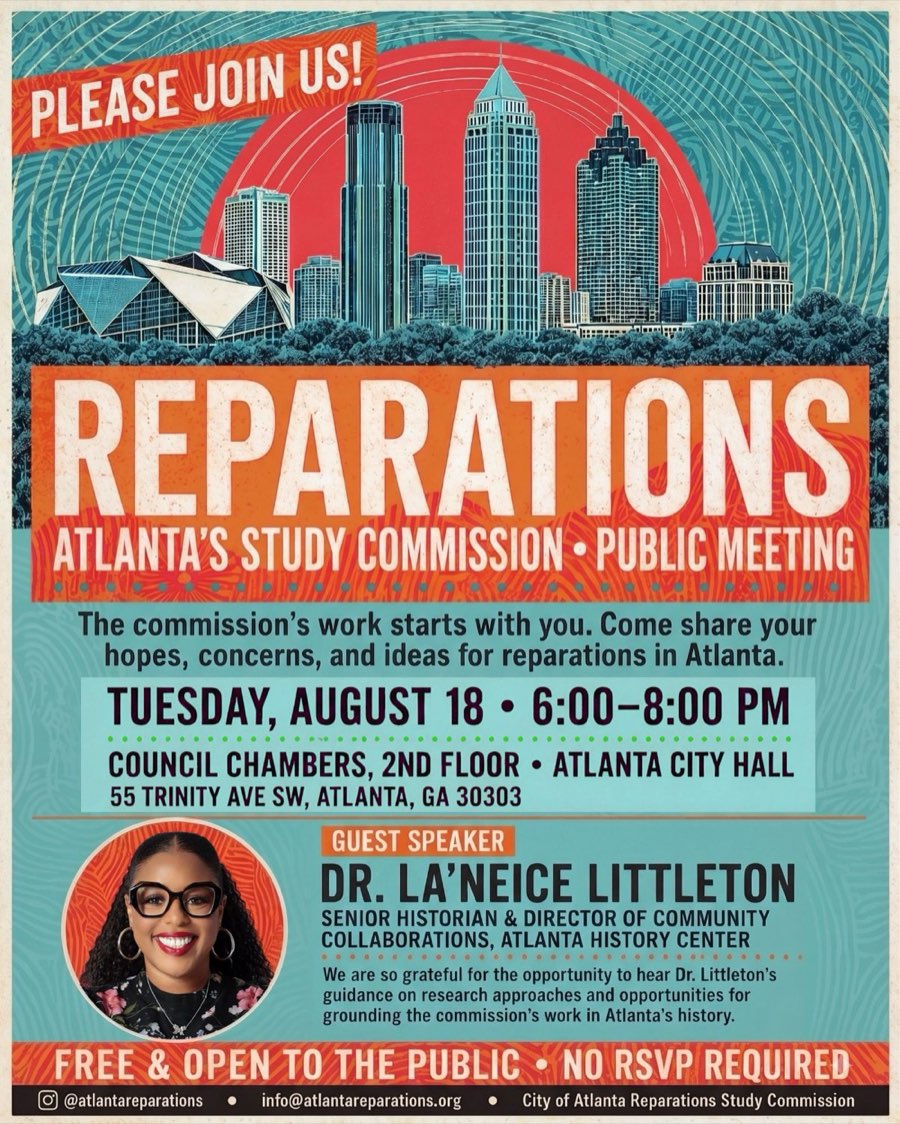
Free & open to the public · No RSVP required
Next date announced here and on Instagram
07 · Commission Desk
The commission works in the open
Commissioners coordinate through a member portal: tasks, meeting materials, scheduling, and working groups. It is built for Georgia's sunshine laws. There are no closed-door discussion threads, records are archived rather than deleted, and everything can be exported under the Open Records Act.
Everything commissioners write in the portal is a public record.
08 · Resources
Documents of record
Records requests: write info@atlantareparations.org. The commission's records are public.